
Architecting Greenfield Agentic Systems: Why Modular Monoliths and Edge-EDA are the New Standard
Explore why the industry is shifting toward Domain-Bounded Modular Monoliths for agentic orchestration and how Event-Driven Architecture (EDA) is utilized at the boundaries.
# Architecting Greenfield Agentic Systems: Why Modular Monoliths and Edge-EDA are the New Standard
*By the EffectiveSolutions.ai Engineering Team*
When engineering teams set out to build greenfield AI platforms—especially those powered by autonomous "agentic" workflows—they often default to the architectural patterns that dominated the last decade of SaaS development: hyper-granular microservices.
The instinct is understandable. If you are building a system that parses a PDF, queries a vector database, invokes a Large Language Model (LLM), and evaluates a compliance score, it is tempting to spin up a "Parsing Service," a "RAG Service," and an "Evaluation Service."
However, in the context of multi-agent AI systems, this fragmented approach quickly degrades into a distributed systems nightmare. Here is why the industry is shifting towards Domain-Bounded Modular Monoliths for agentic orchestration, and precisely how Event-Driven Architecture (EDA) should be used at the boundaries.
The Paradigm Shift: Agentic Systems vs. Microservices
When building systems where AI agents need to autonomously reason, collaborate, and execute continuous state-machine workflows, traditional microservice boundaries introduce critical friction.
High-Bandwidth Context Sharing (Shared Memory)
In multi-agent swarms (such as a "Maker/Checker" loop where one agent drafts content and another critiques it), agents frequently need to pass massive amounts of context. Imagine an agent building a complex Abstract Syntax Tree (AST) of a 50-page legal contract and passing it to a Quality Assurance agent for review.
- In a Monolith: This state is passed instantly via RAM (e.g., using a LangGraph
StateGraph). - In Microservices: You must serialize megabytes of context, pass it over a network boundary via HTTP or gRPC, and deserialize it on the other side. This creates unacceptable latency bottlenecks and drives up token serialization bloat.
Complex State Machines & Orchestration
Agentic workflows are highly dynamic state machines. They loop, retry, spawn sub-agents, and routinely halt to request human-in-the-loop feedback. Managing this fluid, unpredictable orchestration across distributed microservices is an anti-pattern. If an agent pipeline spans three microservices and one fails, rolling back the agent's internal "thoughts" across network boundaries is incredibly error-prone.
Mitigating Latency Compounding
The primary performance bottleneck in any AI application is the LLM inference generation time (Time to First Token). Adding internal network hops on top of external API calls to OpenAI or Anthropic drastically degrades the user experience. Unifying the orchestration into a single backend process eliminates unnecessary network delays.
Local Tool Calling Architectures
Modern agentic systems rely on centralized orchestration where the LLM is provided an array of "Tools" it can execute. It is vastly simpler, faster, and more deterministic to provide an agent with secure, local Python functions to execute directly in-memory, rather than prompting the LLM to correctly construct network payloads, manage authentication headers, and handle state against fragmented internal microservices.
The "Nerves": Event-Driven Architecture (EDA) at the Boundaries
If the internal agentic swarm is the "brain" (kept synchronous and memory-bound to avoid network overhead), then Event-Driven Architecture and Pub/Sub models act as the "nerves." While you should avoid microservices *inside* the agent's reasoning loop, EDA is absolutely essential at the boundaries of the system.
Here is how to properly implement EDA in a greenfield agentic platform:
Triggering the Agent Pipeline (Ingestion)
Because LLM processing is inherently slow, agentic workflows must be asynchronous from the user's perspective.
- The Pattern: When a user uploads a large dataset (e.g., a massive PDF to Azure Blob Storage or AWS S3), the storage bucket emits a
BlobCreatedevent to a Pub/Sub Broker (like Azure Event Grid or Kafka). The monolithic agent backend subscribes to this topic, picks up the event, and *then* initiates the agent swarm in the background.
Decoupling the UI (Server-Sent Events)
An agentic process might take 3 to 5 minutes to run its comprehensive loops. A frontend cannot simply hold an HTTP request open for that long without timing out.
- The Pattern: As the backend processes the task, it emits a continuous stream of events (e.g.,
"agent_thinking","clause_extracted","score_calculated"). These are pushed to the client via WebSockets or Server-Sent Events (SSE). This provides the user with a live, typing-style progress indicator, abstracting away the long-running backend execution.
Cross-Service Communication (Bounded Contexts)
When an agent successfully finishes its internal workflow, it must notify the rest of the enterprise ecosystem without creating tight coupling.
- The Pattern: Once the agentic system finalizes a task (e.g., a contract is approved), it fires a
TaskFinalizedevent into a global Pub/Sub topic. Entirely separate microservices—such as a Billing service, a Telemetry/Analytics backend, or a Learning Management System—listen to this topic to update their own state. The agentic system doesn't need to know these other services exist.
Case Study: Implementation at EffectiveSolutions.ai
At EffectiveSolutions.ai (ES), we architected our flagship Agentic Contract Management (ACM) platform strictly adhering to these principles. ACM operates as a Domain-Bounded Modular Monolith for the heavy AI orchestration, while relying on the broader ES microservice ecosystem and Event-Driven Architecture (EDA) for platform telemetry and UI updates.
Architectural Considerations at ES
- 1.The Monorepo Ecosystem: We use Turborepo to house independent vertical domains. ACM (Legal), DAU (Analytics), and ACH (Marketing Content) are entirely separate microservices. However, *within* the ACM vertical, we did not split the system into "Auth," "PDF Parsing," and "LLM Routing" nanoservices. The entire
acm-backendis a single, robust Python FastAPI process. - 2.Synchronous Internal Swarms: Our ACM Sentinel swarm leverages a Maker/Checker architecture. Because the AST of a 50-page legal document is massive, passing it between a "Drafter Agent" and a "QA Agent" inside a single memory space is instantaneous.
- 3.Decoupled Telemetry: When ACM finishes an analysis, it doesn't execute an HTTP call to our Growth Terminal System (GTS). It fires an event to the message broker, allowing GTS to log the telemetry asynchronously.
The Ingestion & Standardization Gateway
Before the monolithic agent swarm can operate efficiently, it requires clean, deterministic data. Contracts enter the ACM ecosystem across various asynchronous boundaries: direct uploads via the Next.js UI, automated forwarding from enterprise email aliases, and API webhooks from external CRMs.
Rather than building complex, polling microservices for each source, Edge-EDA drives the ingestion phase:
- 1.Event Trigger: All incoming documents, regardless of their origin, are dropped into a secure Azure Blob Storage bucket. This drop instantly fires an
EventGridwebhook payload to the ACM backend. - 2.Standardization Pipeline: The monolithic backend intercepts the event and runs a deterministic (non-LLM) standardization sequence. It executes OCR on scanned PDFs, normalizes the extracted data into clean Markdown, and passes the text through a PII (Personally Identifiable Information) data-masking middleware to sanitize sensitive entities.
- 3.Swarm Handoff: Only after the document is perfectly standardized does the intensive ACM Sentinel LLM swarm take over. This architectural boundary ensures the agents never waste expensive tokens wrestling with fragmented file formats, allowing them to focus entirely on high-level legal reasoning.
4. Expanding the Greenfield Vision: The Omni-Channel Agentic Analytics Platform
🧭 Diagram Walkthrough
- 1.[1 & 2] Ingestion & Scrubbing: Raw unstructured documents (scanned PDFs, Word, PPT) and structured datasets land in Azure Blob Storage, triggering an EventGrid Webhook
[1]to our Multi-Modal Ingestion Engine (utilizing Azure AI Document Intelligence for OCR when necessary). The normalized markdown and JSON payloads are passed[2]to the PII Scrubbing Middleware to redact sensitive information. - 2.[3] Swarm Handoff: The sanitized payload is securely handed off
[3]to the FastAPI Stateless Monolith, where the agentic Maker/Checker swarm begins processing. - 3.[4] Hybrid RAG Operations: The swarm actively queries
[4]both thepgvectordatabase (for semantic similarity) and a Knowledge Graph (for complex entity relationships) to perform Advanced Hybrid Retrieval-Augmented Generation (GraphRAG). - 4.[5 & 8] Live Edge-EDA Communication: While the swarm runs its intensive loops, it continuously streams its state
[5]to the Next.js UI via Server-Sent Events (SSE) and emits telemetry[8]to the Global Neural Feed via Redis PubSub. - 5.[6 & 7] Human-in-the-Loop Validation: Once the swarm finishes, the results are parked
[6]in an Intelligence Staging queue. After human validation, they are committed[7]to the Final Analytics Data Lake.
While the case study above focuses on legal contracts, the *Modular Monolith + Edge-EDA* architecture is the optimal foundation for a broader, generalized Omni-Channel Agentic Analytics Platform. Imagine a greenfield system designed to ingest unstructured documents (scanned PDFs via OCR, PowerPoints, raw text) alongside structured datasets (Excel, SQL databases) to provide advanced, multi-agent analytics through an interactive chatbot interface.
Here is how this architecture natively satisfies critical enterprise "-ilities" and operational requirements:
4.1 Omni-Channel Ingestion & Security (Confidentiality & Compliance)
*🗺️ Maps to Diagram Flow [1], [2], and [3]*
- Unified Standardization Pipeline: Using Edge-EDA, any dropped file—whether a raw Excel sheet, a PowerPoint deck, or a scanned image requiring Tesseract OCR—triggers an asynchronous ingestion event. The system routes the payload to deterministic parsers to normalize everything into a unified Markdown/JSON format *before* the LLM swarm sees it.
- PII Cleansing & Data Masking: Security is paramount. Before any normalized text enters the agentic "brain," it passes through a deterministic regex/NER scrubbing middleware. Social Security Numbers, financial data, and personal names are replaced with safe tokens (e.g.,
[PERSON_1]). - Enterprise Identity & Zero-Trust: The Next.js frontend authenticates users via Azure Entra ID (OIDC/OAuth2), passing secure JSON Web Tokens (JWTs) through the edge proxies to the FastAPI backend.
- Tenant Isolation: Row-Level Security (RLS) at the PostgreSQL database level seamlessly maps to these JWT claims. This guarantees that vector embeddings and Knowledge Graph nodes are cryptographically partitioned. Agentic swarms can physically only query data authorized for the active user's session.
:::acm-pane How EffectiveSolutions Implements This
EffectiveSolutions' ACM utilizes a Google Cloud Storage (GCS) Eventarc webhook (the GCP equivalent of an Azure Blob Storage EventGrid webhook) that automatically triggers a deterministic pipeline. It converts legal PDFs to Markdown via OCR using Google Cloud Document AI (the equivalent of Azure AI Document Intelligence) and runs a proprietary PII-scrubbing middleware before the contract ever reaches the LLM. Extracted vector data is fortified by PostgreSQL Row-Level Security (TenantMixin), ensuring absolute tenant isolation.
🏛️ Architectural Considerations
By hooking into Azure EventGrid at the storage boundary, the heavy multi-modal parsing, OCR, and standardization processes are completely decoupled from the synchronous HTTP request flow. This prevents client timeouts during massive batch uploads and complex dataset processing.
- Line 13:
ocr_and_standardizeconverts proprietary formats (PDFs) into clean Markdown, providing the LLM with deterministic, high-signal data. - Line 16: The
pii_scrubberacts as a security firewall, masking sensitive entities before they ever touch the LLM's context window. - Line 19: The sanitized payload is handed off to the internal agentic swarm asynchronously.
:::
4.2 Advanced Agentic Analytics & Chatbots (Usability & Extensibility)
*🗺️ Maps to Diagram Flow [3] and [5]*
- The Data Science Swarm: Inside the Modular Monolith, a specialized analytics swarm operates. A *Router Agent* receives a user's chatbot query ("Why did Q3 revenue dip in EMEA?"). It delegates to a *SQL-Agent* to query the structured Excel data, and a *RAG-Agent* to search the unstructured PowerPoint decks.
- Interactive Chatbots (Server-Sent Events): As these agents synthesize data across diverse sources, the chatbot UI receives live updates via SSE. The user sees the agent's "chain of thought" in real-time, building trust in the analytical process.
:::acm-pane How EffectiveSolutions Implements This ACM’s backend (a FastAPI Modular Monolith) utilizes a Maker/Checker swarm—comprising Scout, Inspector, and Drafter agents—to synthesize massive legal ASTs. As these agents debate and redline contracts, their intermediate states are streamed directly to the Next.js frontend via Server-Sent Events (SSE), offering lawyers a real-time window into the agent’s "thinking" process.
🏛️ Architectural Considerations
Server-Sent Events (SSE) provide a unidirectional, low-overhead pipeline to stream tokens to the UI. Unlike WebSockets, SSE operates over standard HTTP, simplifying load balancing and preventing stateful connection drops.
- Line 9: Opens a persistent HTTP connection to the FastAPI monolithic backend.
- Line 12-13: Listens for granular
agent_thinkingevents, appending them to the UI state to build trust through transparency.
:::
4.3 Observability, Traceability, & Auditability (Reliability & Maintainability)
*🗺️ Maps to Diagram Flow [8]*
- Agentic Traceability & Auditability: Enterprise platforms cannot be black boxes. Every tool call, LLM prompt, and generated response is logged into an immutable audit ledger. If an agent concludes that Q3 revenue dipped due to a supply chain issue, the platform provides trace links directly back to the source PowerPoint slide or database row.
- Deterministic Guardrails: To ensure reliability, outputs from the analytics agents must conform to strict Pydantic schemas. If a *Visualization Agent* proposes a chart, it must output a valid JSON configuration for Recharts; otherwise, a deterministic guardrail intercepts the payload and forces a retry, preventing malformed UI renders.
- Observability via EDA: Analytics swarms can take minutes to run deep correlations. By emitting milestone events to an external message broker, external observability platforms (like Datadog or Splunk) can monitor swarm health, latency, and token consumption without burdening the monolith.
:::acm-pane How EffectiveSolutions Implements This
ACM enforces strict agentic traceability using Neural Integrity Forensic Loops. Every tool invocation is logged into a policy_audits PostgreSQL table. When an agent flags a risk, the system enforces Pydantic schema guardrails to guarantee the output matches the required JSON shape for the UI, or the payload is deterministically rejected.
🏛️ Architectural Considerations
Logging LLM calls isn't enough; the system must trace the exact *reasoning* pathway. By writing emit_signal telemetry to a Postgres relational table, the platform enables strict auditing and SQL-based reporting on agent behaviors.
- Line 9-13: Constructs a strongly-typed audit record containing the agent's identity and specific context (e.g., the exact prompt used).
- Line 17: Commits the record immutably for compliance and traceability.
- Line 20: Broadcasts the event to the global observability feed asynchronously.
:::
4.4 Elastic Scalability (Scalability & Performance)
*🗺️ Maps to Diagram Flow [3]*
- Because the heavy agentic reasoning is contained within a stateless Modular Monolith, scaling is trivial. As the EDA ingestion pipeline queues up thousands of incoming documents, container orchestration (like Kubernetes) can seamlessly horizontally scale the backend based on queue depth. The monolith flexes to handle the load and scales down to conserve costs, completely bypassing the headaches of distributed microservice scaling.
:::acm-pane How EffectiveSolutions Implements This Because the ACM backend is a stateless Python FastAPI process, it perfectly leverages Kubernetes Horizontal Pod Autoscaling (HPA). When an enterprise uploads 10,000 legacy contracts for batch processing, the EDA queue depth spikes, and the infrastructure seamlessly spins up identical monolithic pods to digest the load, scaling back down to zero when the queue clears.
🏛️ Architectural Considerations
Because the Modular Monolith is completely stateless (sharing context via the Postgres DB and Redis), it effortlessly maps to Kubernetes Horizontal Pod Autoscaling (HPA) metrics, eliminating the complex choreography of scaling 15 distinct microservices.
- Line 16-17: Defines the elasticity bounds (scaling from 2 up to 50 monolithic pods).
- Line 22-25: Triggers scaling based on the *external* EDA queue depth, spinning up a new backend pod for every 100 pending documents in the batch ingestion queue.
:::
4.5 Contextual UI: Intelligence Bubbles (Usability & Transparency)
*🗺️ Maps to Diagram Flow [5]*
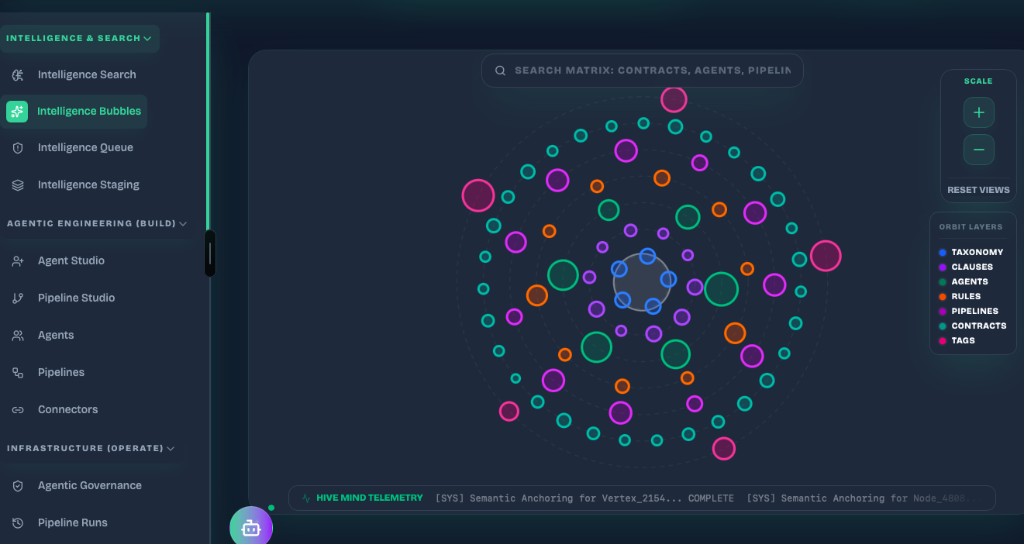
- Neural Topology Map: As the system scales to thousands of documents, traditional folder structures collapse under the weight of semantic complexity. A greenfield platform employs a high-density Neural Topology Map (often referred to as Intelligence Bubbles) to visualize the hidden relationships between enterprise assets. Instead of static lists, users interact with a visual web that clusters conceptual documents, flags anomalous AI agents (like idling "Orphaned Agents"), and illuminates live data flows.
- Forensic Drift Analysis: Selecting a node in the Intelligence Bubbles activates a dual-panel readout. It provides a synthesis of the node's function (System Insights) and a raw, immutable ledger trace of its history, giving users a God's-eye view of their entire operational estate.
:::acm-pane How EffectiveSolutions Implements This ACM features an interactive "Intelligence Bubbles" screen—a vivid spectroscopic orbit system. It organizes Taxonomies, Clauses, AI Agents, Rules, Pipelines, and Contracts into concentric rings. When users select an AI Agent, they can instantly see the neural connections highlighting every Pipeline it operates in and every Contract it is currently analyzing, complete with live Anomaly Highlights for high-risk assets.
🏛️ Architectural Considerations
Visualizing thousands of complex nodes requires sophisticated frontend state management. By treating the entire enterprise estate as a localized Graph, the UI can render dynamic, interactive topologies without forcing the user to mentally parse massive data tables.
- Line 9-11: Dynamically calculates the CSS offsets by reading the bounding box of the actual rendered text in the browser.
- Line 15-17: Renders the "Bubble" directly adjacent to the controversial clause, displaying the agent's deterministic confidence score.
:::
4.6 Hybrid Search: Vector Embeddings & Knowledge Graphs (GraphRAG)
*🗺️ Maps to Diagram Flow [4]*
- While standard Retrieval-Augmented Generation (RAG) using
pgvectoris excellent for finding semantic similarity (e.g., *"Find clauses similar to this indemnification"*), it completely falls apart when attempting to understand complex, multi-hop entity relationships. - The Knowledge Graph (GraphRAG): To solve this, the platform natively integrates a Knowledge Graph (like Azure Cosmos DB for Apache Gremlin or Neo4j). As the ingestion engine extracts data, it builds a massive web of nodes and edges. When a user asks a complex question (e.g., *"Which of our subsidiaries are exposed to supply chain risks via vendors owned by Company X?"*), the agentic swarm executes a Hybrid Search. It uses vector search to find the conceptual documents, and simultaneously traverses the Knowledge Graph to explicitly map the ownership and liability dependencies.
- Saved Semantic Views: Users can save these GraphRAG searches as dynamic, materialized views. As *new* documents are ingested, they update the Knowledge Graph in real-time, proactively alerting users if a new connection violates a saved rule.
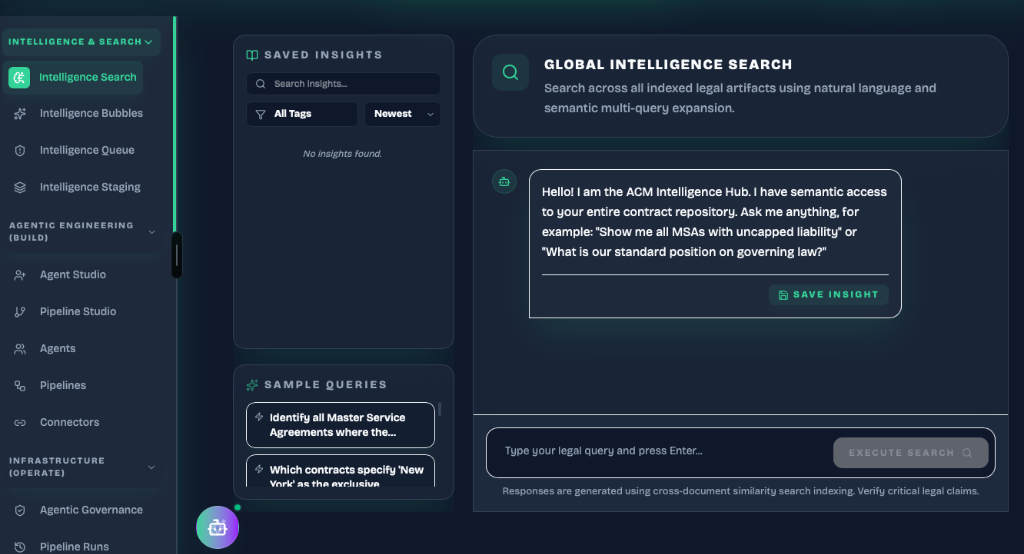
:::acm-pane How EffectiveSolutions Implements This ACM utilizes GraphRAG to map complex corporate hierarchies and contract dependencies. If a Master Services Agreement (MSA) is amended, the Knowledge Graph immediately highlights all downstream Statements of Work (SOWs) and Vendor Agreements that are legally impacted by the amendment, allowing the swarm to recursively analyze the blast radius.
🏛️ Architectural Considerations
Decoupling the semantic embeddings (pgvector) from the entity relationships (Knowledge Graph) ensures that each database operates at peak efficiency. Offloading the heavy GraphRAG traversals to background worker queues ensures that continuous evaluation doesn't block the synchronous API threads.
- Line 12: Retrieves all saved, persistent RAG queries defined by the enterprise.
- Line 16-19: Executes a highly efficient Cosine Similarity calculation directly inside PostgreSQL using the
pgvectorextension. - Line 22-23: Proactively alerts the user if the new document conceptually matches the saved risk profile.
:::
4.7 Agent Studio & Pipeline Builder (Low-Code Orchestration)
*🗺️ Maps to Diagram Flow [3]*
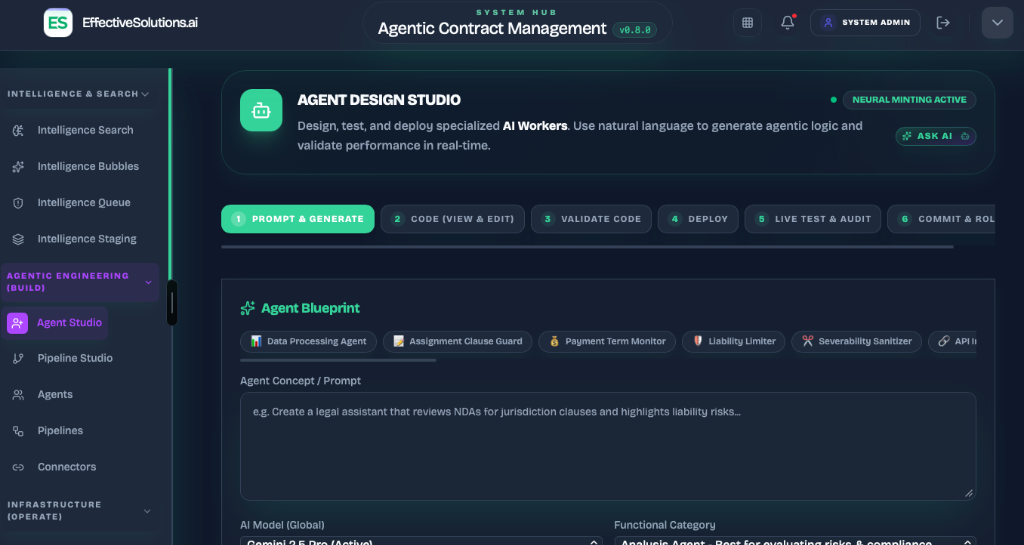
- Agent Studio: Instead of hardcoding every agentic workflow, a greenfield platform exposes an administrative Agent Studio. Here, domain experts and business logic owners can define custom analytics agents. They can configure system prompts, select specialized tools (e.g., SQL execution, internal APIs), and mandate deterministic Pydantic output schemas (guardrails) without writing raw Python code.
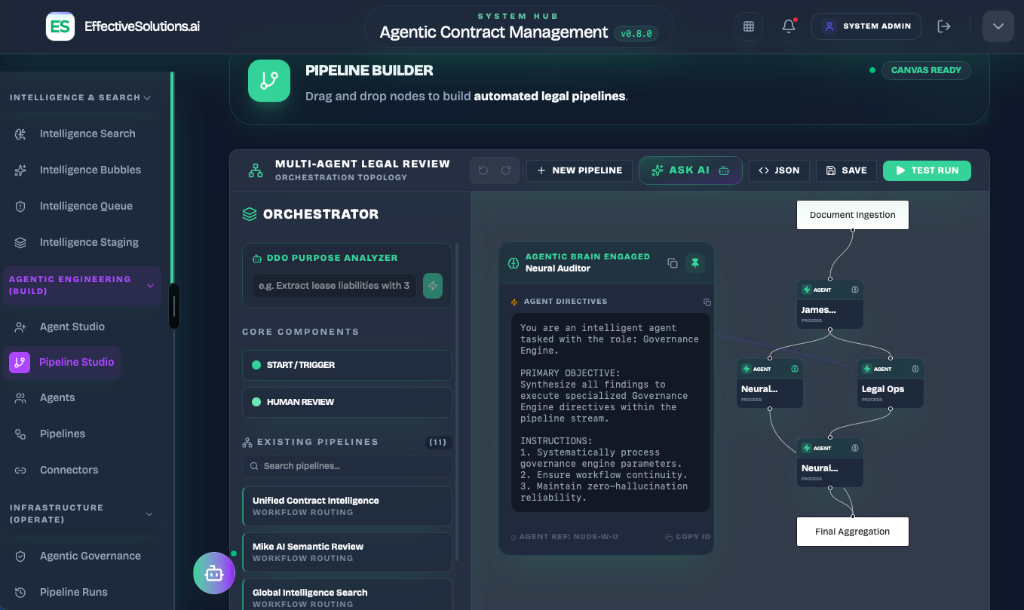
- Pipeline Studio: Once individual agents are created, they are stitched together in the Pipeline Studio. This visual, drag-and-drop orchestration layer allows administrators to dynamically wire complex multi-agent flows. For example, an *Ingestion Node* triggers an *OCR Agent*, which routes normalized text to a *Financial Analysis Agent*, eventually terminating at a *Visualization Agent*. This visual orchestration turns the monolithic backend into an infinitely extensible agentic engine.
:::acm-pane How EffectiveSolutions Implements This EffectiveSolutions provides an administrative "Agent Studio" where Legal Ops teams (not engineers) can define custom legal agents (e.g., "GDPR Reviewer"). These agents are then wired together in the "Pipeline Builder", a visual React Flow interface where users drag and drop nodes to create custom workflows (e.g., Intake Node -> NDA Agent -> GDPR Agent -> Finalization).
🏛️ Architectural Considerations
Visual orchestration abstracts Python state-machines into serialized JSON graphs. This empowers non-technical domain experts (like Legal Ops) to dynamically route data between specialized agents without deploying new backend code.
- Line 8-11: Defines the physical position and core identity of the agent node in the Pipeline Builder canvas.
- Line 12-16: Configures the agent's prompt persona, specifies the LLM engine, enforces a rigid Pydantic output schema (
GDPR_Violation_V1), and provisions external tools.
:::
4.8 AI X-Ray Checks (Deep Explainability)
*🗺️ Maps to Diagram Flow [5]*
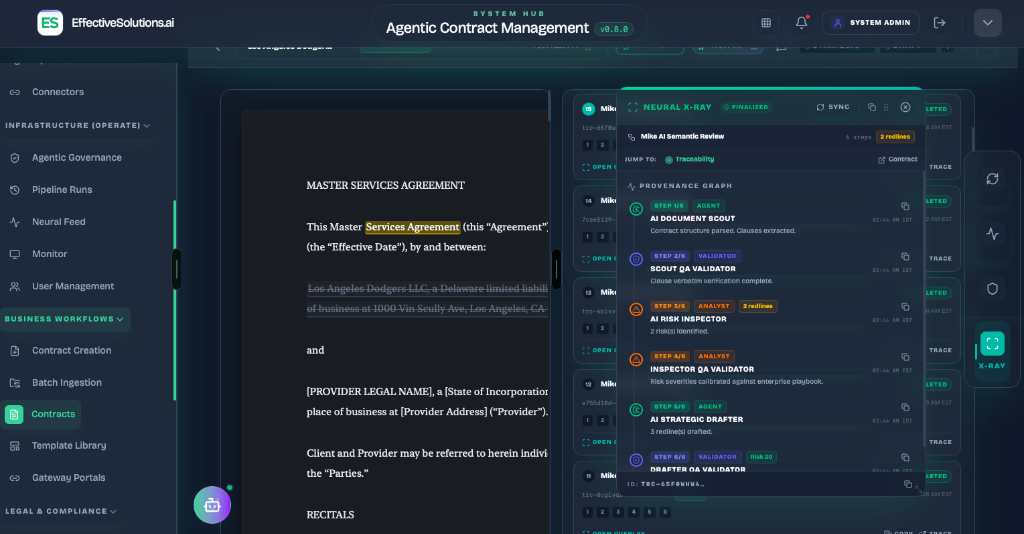
- Enterprise users inherently distrust AI-generated analytics that function as "black boxes." To solve this, the platform implements AI X-Ray Checks. When a user views an AI-generated dashboard or chatbot response, they can toggle an "X-Ray Mode." This feature visually highlights the exact citations in the underlying source material. If the swarm identifies a revenue anomaly, the X-Ray Check draws a direct trace link to the specific row in the Excel spreadsheet or the exact paragraph in a scanned PowerPoint slide, exposing the agent's intermediate logic and effectively eliminating hallucination anxiety.
:::acm-pane How EffectiveSolutions Implements This When the ACM swarm generates a risk summary, lawyers can toggle "X-Ray Mode." Doing so visually snaps the document viewer to the exact underlying citation in the raw contract text. This 1-to-1 trace link proves precisely which sentence triggered the LLM's logic, eliminating the fear of AI hallucinations.
🏛️ Architectural Considerations
Explainability is a prerequisite for enterprise adoption. By forcing the LLM to output verbatim text citations (quotes) alongside its analysis, the frontend can search the DOM and visually anchor the agent's logic to the raw source truth.
- Line 9: Relies on the agent returning an
exact_citationstring within its Pydantic output schema. - Line 12: Locates the precise HTML element containing the citation.
- Line 16: Snaps the viewport to the source truth and highlights it, visually verifying the agent's logic.
:::
4.9 Intelligence Staging & Asynchronous Queues (Human-in-the-Loop)
*🗺️ Maps to Diagram Flow [6] and [7]*
- Intelligence Staging: Autonomous agents are powerful, but enterprise data requires absolute trust. Before an agent's final analytical report or data transformation is committed to the broader ecosystem, it is held in Intelligence Staging. This acts as a strict Human-In-The-Loop (HITL) buffer. A human data analyst can review the swarm's proposed SQL changes, charts, or strategic conclusions, adjust them if necessary, and explicitly approve them. This ensures AI hallucinations never silently corrupt business intelligence.
- Intelligence Queue: Because deep, multi-agent research can take several minutes to run complex cross-references, tasks are placed in an Intelligence Queue. Users do not stare at blocking loading spinners; they dispatch asynchronous analytical goals to the swarm and are notified when the output is ready in the staging area for review.
:::acm-pane How EffectiveSolutions Implements This ACM explicitly implements an "Intelligence Staging" gateway. Proposed contract redlines are held in a "Waiting on Intelligence" queue. The system requires a human lawyer to review the agent's proposed edits and click "Approve" or "Reject" before the redlines are finalized, guaranteeing a strict Human-In-The-Loop safety buffer.
🏛️ Architectural Considerations
The transition from "AI Suggested" to "Enterprise Approved" represents a critical state boundary. By implementing a dedicated staging table, the platform physically isolates unverified AI outputs from production data lakes until cryptographically signed by a human.
- Line 11: Retrieves the pending AI payload from the isolated staging table.
- Line 16: Executes the actual database mutations only *after* the endpoint is invoked by an authorized human.
- Line 19-23: Records the exact human actor who approved the AI's logic, satisfying compliance and auditability requirements.
:::
4.10 Agentic Governance & The Loop Governor (Safety & Budget Control)
*🗺️ Maps to Diagram Flow [3]*
- Taxonomies & Validation Rules: Agents must operate within a strict perimeter of business logic. Using centralized Validation Rules and Taxonomies, administrators define the boundaries of reality (e.g., forcing financial agents to strictly use standardized enterprise tagging). If an agent attempts to categorize a dataset with a hallucinated tag, the system deterministically rejects it.
- The Loop Governor: Autonomous state machines can occasionally fall into recursive "infinite loops" (e.g., an agent writes bad SQL, receives an error, and retries the exact same bad SQL indefinitely). The Loop Governor acts as a hard enterprise circuit breaker. It continuously monitors the swarm's recursive cycles and forcefully terminates any agent loop that exceeds a predefined iteration threshold, protecting both compute resources and LLM API budgets.
:::acm-pane How EffectiveSolutions Implements This
ACM agents are rigorously bound by centralized Legal Taxonomies. If an agent attempts to categorize a clause using a fabricated tag, the payload fails validation. Furthermore, the remediation-governor acts as a hard circuit breaker for the Maker/Checker loop, strictly terminating the agent swarm after a maximum of 5 recursive iterations to prevent infinite generation loops.
🏛️ Architectural Considerations
Unchecked recursive loops can catastrophically drain LLM budgets. Coupling strict Pydantic schemas with an iteration governor ensures that the swarm either converges on a valid solution quickly, or gracefully degrades and alerts a human.
- Line 8-11: Defines an immutable
Enumtaxonomy. If the LLM hallucinates a category like"SECURITY_RISK", Pydantic instantly rejects the payload. - Line 19-20: Establishes the hard loop limit (
MAX_ITERATIONS). - Line 27: Escapes the loop and escalates to a human, preventing infinite recursion.
:::
4.11 Infrastructure: Neural Feeds & Secure Connectors (Observability & Integration)
*🗺️ Maps to Diagram Flow [8]*
- Secure Connectors: A robust analytics platform cannot rely solely on manual file uploads. Admins configure Connectors (e.g., Snowflake, Salesforce, AWS S3) within the platform. These connectors act as secure, credentialed bridges (often utilizing OAuth and RBAC), giving agents permissioned access to external data silos without ever exposing raw API keys to the LLM's prompt.
- The Neural Feed: For system administrators, monitoring a swarm of hundreds of active agents requires a God's-eye view. The Neural Feed is a live, real-time telemetry ticker that streams every major agentic action across the platform. Whether a RAG-Agent in the EU region triggers a database connector or a SQL-Agent is halted by the Loop Governor, it appears instantly on the Neural Feed, ensuring total platform observability.
:::acm-pane How EffectiveSolutions Implements This ACM seamlessly links to external enterprise systems via Secure Connectors (like Salesforce CPQ or Ironclad) using OAuth, giving agents the contextual deal metadata they need without exposing API keys. Administrators monitor all this activity through the ACM "Neural Feed," a global real-time ticker broadcasting every agentic milestone, DB query, and staging event across the entire platform.
🏛️ Architectural Considerations
Global platform observability requires a low-latency pub/sub backbone. By utilizing Redis PubSub, the platform can aggregate millions of discrete agentic events across horizontally scaled pods and broadcast them to a unified administrative dashboard.
- Line 13-18: Formats the agent's real-time action (e.g.,
"INVOKED_SQL_CONNECTOR") into a standardized JSON payload. - Line 21-24: Publishes the payload to the Redis
global_neural_feedchannel, where the administrative UI is actively listening via WebSockets to render the live ticker.
:::
4.12 Enterprise CI/CD, DevOps, & Infrastructure-as-Code
*🗺️ Maps to Platform Operations & Delivery*
- Infrastructure-as-Code (IaC): The entire Azure architecture (Container Apps, Blob Storage, PostgreSQL Flexible Server, EventGrid) is provisioned declaratively using Terraform/Bicep. This ensures environments (Dev, Staging, Prod) are perfectly reproducible and immune to configuration drift.
- Zero-Downtime CI/CD Pipelines: Automated GitHub Actions / Azure DevOps pipelines handle the SDLC. Pushes to main trigger strict automated testing (linting, unit tests, integration tests) before building highly-optimized Docker containers. The containers are seamlessly pushed to the Azure Container Registry and deployed to Container Apps via blue/green deployments.
- OpenTelemetry & Full-Stack Observability: The system utilizes OpenTelemetry standards to track requests entirely from the Next.js edge, through the FastAPI monolith, and down into the pgvector database and LLM API calls. This allows DevOps teams to monitor token latency, pinpoint bottlenecks, and ensure the Agentic pipeline meets enterprise SLAs.
5. Conclusion
For greenfield agentic development, the architectural rule of thumb is simple: Keep the reasoning tight, and the notifications loose.
By consolidating your LLM orchestration, prompts, and tool executions into a single, highly-optimized Domain-Bounded Modular Monolith, you eliminate crippling network latency and state-management nightmares. Then, by wrapping that monolith in robust Event-Driven Architecture, you ensure it scales safely, reports state cleanly to the UI, and integrates seamlessly into the broader enterprise microservice ecosystem.
Build with our
Architects
Bring your legacy silo data to life with autonomous reasoning swarms.
Book Review